




Why Lease?

Leasing: What’s right for you?
Both leasing and buying have advantages and disadvantages, just like renting versus buying a house. Choosing to buy or lease a car depends on your situation; and, everyone’s situation is different. So, what makes sense for you?
Buying, borrowing, leasing
There are three main ways to go: paying cash, taking out a loan, and leasing. So, what’s the best choice? Obviously, paying cash is ideal, but it’s not usually an option as vehicles continue to get more expensive.
Leasing used to be confined to corporate and luxury cars, but now it’s available for just about any car, van, or truck. Today, one-third of cars are leased.
Leasing is always an option to consider and comes with a number of perks. These include:
- No negative equity at the end
- You don’t own a vehicle until it’s paid off anyway
- You will most likely pay cheaper business taxes
- The car is always under warranty
- You can save money if you always drive new cars
Leasing Options
Leases are available for vehicles spanning a wide price range. Talk to us about what car you had in mind and your preferred monthly payment, and we can start to make a plan depending on your needs.
No negative equity at the end
Buyer beware
When you buy a new car, you take on the risk of market fluctuations in your car’s sale or trade-in value.
Predicting the future
With leasing, the future value is laid out. If the car’s value is less than the determined amount at the end of the lease, you’re not under water. You’ll never own more on the car than what it’s worth.
You don’t own a vehicle until it’s paid off
You don’t own your car or truck until you’ve made the last payment. Sometimes it’s helpful to think less about who owns the car and more about how much utility you’ll get out of the car over a specified timeframe.
Pay cheaper taxes
Driving for business
When you lease, a portion of the car’s depreciation and financing is tax deductible. Consult the IRS’s website for how to calculate tax deductions.
Always under warranty
Leases are predictable
Leases are great for paying a predictable amount per month. This allows you to better plan your budget. Many leases last for three years, which is the length of the typical manufacturer’s warranty for a new car. This means unexpected repairs during the lease are usually not up to you to pay. However, you are required to get your own oil changes, tire rotations, and other maintenance. This is important and shouldn’t be overlooked, as neglecting proper upkeep can result in fees at the end of your lease.
You can save money if you always drive new cars
You’re always driving a new car
If you enjoy having the latest car model, leasing allows you to do just that. Every three years you can switch to a new model. You also don’t have to go through the process of selling a car to accomplish this.
If you pay $300 on a lease instead of $500 to buy, in three years you save $7,200 in payments. If in three years you try to trade in that same car, you won’t have that much equity in the vehicle. While car loans are more common, leasing usually allows drivers access to a more expensive vehicle than if they took out a loan.
F&I Products (Finance and insurance products) that make sense for a lease
Whether you have perfect credit, or have room for improvement, our finance department can help you finance your vehicle and get you on the road!
—
Benefits of leasing a car
When you purchase a car, the loan value is based on the entire cost of the vehicle minus your down payment and trade-in value.
Buying a car:
(cost of vehicle) – (down payment) = what you pay
When leasing, you only finance the depreciation that occurs during the lease term (most commonly three years) plus fees. You only pay the difference between the car’s current price and what the car is expected to be worth at the end of the lease, known as its residual value.
Leasing a car:
(car depreciation) + (fees) = what you pay
This means that, unless you have a large down payment, your monthly payment is mostly likely going to be a lower monthly payment.
For example:
A car costs $30,000
You put down 10 percent ($3,000)
You finance $27,000
The lease’s predetermined residual value is 55 percent ($16,500)
In this example, you’d only make payments on the $13,500 worth of expected use.
—
No down payment (often) needed
If you don’t have much money saved up, leasing might be a good option. Car leases require zero to several thousand dollars down. Many of the better leasing deals offer low monthly payments, but a high down payment.
Money down
When buying, many lenders require 10 to 20 percent down. Loans that stretch payments over eight years increase the overall cost. Interest rates on long-term loans themselves tend to be higher as well. The benefits of leasing are numerous; however, there are some drawbacks that you should be aware of if you are to make an informed decision.
Drawbacks of leasing
Going the extra mile
Leasing isn’t for everyone. If you log a lot of miles on your car you might exceed the allotted amount in your contract, which is usually 9,000 to 15,000 miles per year, with 12,000 being the most common.
Do the math to figure out your commute to work and the other places you go. Or, keep a driving diary for a month to track your miles so you know ahead of time what your pattern of mileage is. If you just drive locally to work and the grocery store, leasing could be a good option. If you have a long commute and go on road trips often, then not so much.
If you exceed your allotted number of miles, you will need to pay a fee at turn-in. Your lease might impose a 20-cent-per-mile fee for miles over maximum, which can add up fast.
Equity
Another drawback with leasing is you’re basically renting the car, meaning at the end of the lease you won’t have built up any equity in the car.
Benefits of buying
If you keep your vehicle a long time buying is better. When you pay off the loan you own the car outright. Throughout the loan, you gain equity in the car so long as payments outpace depreciation.
You can also rack up as many miles on your car as you want without penalty (well, the car will eventually wear out, but you know what I mean!).
Straight sailing (or driving!)
Car loans are straightforward. You borrow money from acreditor, make monthly payments, made up of interest and principle, for a set number of years. You build equity until you own the car outright.
What’s to like about leasing
Monthly payments are lower because you’re not paying principal. You pay the amount that the car depreciates during the time you have it plus finance charges.
Car damage
If you get scratches or dents you face steep wear-and-tear fees (typically limited three months’ worth of lease payments).
Bottom line?
Run the numbers for your situation. Your decision comes down to you.
Taking out a car loan and keeping the car for as long as it runs is the best way (and the most cost efficient way) to go for most people. Leasing is good for people who either can’t afford the monthly payments of a car loan or want the convenience of driving a new car that’s unlikely to need to be in the repair shop.
Links:
https://cars.usnews.com/cars-trucks/buying-vs-leasing
https://www.consumerreports.org/buying-a-car/pros-and-cons-of-car-leasing/
https://lifehacker.com/5858640/should-i-buy-or-lease-a-car
https://www.irs.gov/publications/p463#en_US_2010_publink100034045
3 Things that make a safer car: Part 2
Features that keep you safe
Some safety capabilities are a few years old, but have only been available in high-end luxury cars. Luckily – for all drivers – some features are starting to become standard on regular, mainstream models. Other safety features are headed that way.
In part one, we discussed safety features including crash test ratings, crash avoidance technology, and spare tire location. For part two we’ll be talking about back up sensors, crumple zones, and red interior lighting.
- Crash Avoidance Tech: Back Up Sensors
- Crumple Zones
- Red Interior Lights
With that, let’s dive in!
- Crash Avoidance Tech: Back Up Sensors
Not a fan of parallel parking? Who is?! Luckily, back up sensors were invented and are here to help.
Back up sensors are designed a few ways. They are typically powered off of your reverse lights. Some systems combine ultrasonic sensors with a backup camera for even more thorough coverage. Some systems display how far you are away from objects behind you. Other systems display red, yellow, and green lights to communicate how much room you have. It’s like having someone outside saying, “Keep going, keep going … stop!” Yet other systems provide audio alerts when you’re getting too close. Finally, some systems provide a combination of visual and auditory warnings.
Some back up sensors come with sensors on all sides of the car; others do not. Backup sensors use high frequency sound, above the threshold of human hearing, to detect obstacles. This technology mimics the way bats use echolocation. (So, technically you could say you have a Batmobile! How cool is that?)
Logically enough, the more sensors your car has, the more accurate its warning feedback. This can be an important factor to consider. If a warning system warns when there’s nothing wrong you might be tempted to simply turn it off. No one like the boy who cried “Wolf!” But then that negates the whole purpose of having the system in the first place. The IIHS says some autonomous braking systems are more effective, but all systems provide a net benefit.
Bottom line? If you get one, get a good one. But if you don’t, leave it on!
- Crumple Zones
Crumple zones, also call a crush zones, refers to the areas of a vehicle that are designed to deform (a.k.a. crumple) in a collision. This absorbs energy from the impact, meaning less impact on occupants should there be a crash.
Of course, keeping people safe in auto accidents isn’t as simple as making the whole vehicle crumple. Engineers consider vehicle size and weight, frame stiffness, and the stresses the car will face in a crash. Simple physics, if a race car is racing or an SUV weighs a lot, it’s going to crash with more force, which must be considered in its safety design.
Crumple zone designs vary depending on the size and weight of the vehicle. Simple designs use frame segments built to bend or collapse onto themselves. Advanced designs engineer metals and other materials to absorb kinetic energy. Some cars use a honeycomb design, which offers stiffness and the ability to collapse in a crash.
- Red Interior Lights
Ambient lighting, as long as it’s not so bright that it produces glare, also makes drivers feel safer. While feeling safer isn’t the same as being safer, red ambient lighting does that as well!
Scientists have known that color activates enzymes in the brain that trigger emotional responses for a while. Advertisers picked up on the phenomena as well. Now car makers are getting in on the action. However, instead of selling products, they’re promoting safety. Red interior lighting has been found to make drivers more alert, leading to fewer accidents.
No matter the type of vehicle you are considering purchasing, you should do your research on available safety features. Stop in and talk to a friendly salesperson at Thelen Auto Group and we’ll drop all the knowledge you need to learn about safety features on the quality vehicles on our lot.
Links:
http://www.iihs.org/iihs/ratings/crash-avoidance-features
https://auto.howstuffworks.com/car-driving-safety/safety-regulatory-devices/crumple-zone.htm
https://www.wired.com/2010/08/ambient-lighting-makes-drivers-feel-safer/
https://www.torquenews.com/1080/mood-lighting-your-car-next-evolution-safety
http://mycarneedsthis.com/the-best-parking-sensor-systems-to-buy/
https://www.toptenselect.com/top-10-best-reverse-parking-sensors-cars/
3 Things That Make A Safer Car
Safety first
It’s your worst nightmare. Your kids are driving to the grocery store and then you get a phone call. Accidents happen, but we want them to happen as infrequently as possible; and when they do happen, we want the effects to be minimal.
This can be achieved through testing vehicles in real-life crash simulations and applying knowledge gained to vehicle technology that helps drivers avoid accidents or mitigates damage when an accident occurs. There are, however three key things that you can look for if you are looking into how safe a vehicle may be.
- Crash Test Rating
Vehicle safety ratings
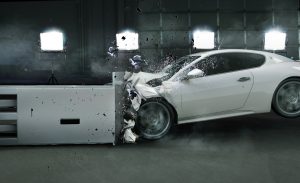
The Insurance Institute for Highway Safety (IIHS) conducts tests that evaluate “crashworthiness” and “crash avoidance and mitigation.”
Crashworthiness – How well occupants are protected
Crash avoidance and mitigation – Technology that prevents or mitigates the severity of a crash.
Crashworthiness ratings include the designations:
- Good
- Acceptable
- Marginal
- Poor
The IIHS also uses this rating system for vehicle headlights.
Vehicles that include front crash prevention systems are rated basic, advanced, or superior.
The criteria IIHS uses for vehicle safety rating includes:
- Driver-side small overlap front
- Passenger-side small overlap front
- Moderate overlap front
- Side
- Roof strength
- Head restraints
When shopping for a new vehicle, do your homework and visit IIHS’ site to view the report on vehicles you are interested in.
- Crash Avoidance Technology
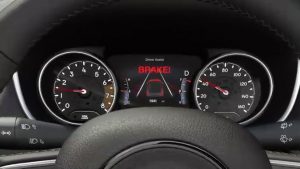
Lane Departure Warning (LDW) and Lane-Keeping Assist (LKA)
LDW warns and LKA assists. Easy enough! 70% of consumers say they are “very satisfied” with both Lane Departure Warning and Lane-Keeping Assist, according to Consumer Reports.
How does it work?
Lane-Keeping Assist uses the painted lines on the road to keep you … well … within the lines! If you drift you will hear an alert, your dashboard will light up, or your steering wheel or seat will vibrate. If you don’t act to correct your position on the road, the system will glide away from the line, doing it for you. Turning your wheel deactivates the system.
A couple downsides are that it doesn’t work in winter when the system can’t see the lines! The other issue is that if you are pulling toward the median to give cyclists and pedestrians space, the system thinks you’re drifting and will drift back to “correct” you. This can scare the driver and the cyclist. Just make sure if you’re allowing others room on the road to turn the wheel to deactivate the system.
The technology still has a lot of room to grow, but consumers who have used it appreciate the technology. If you haven’t had enough coffee or on a long drive and start to drift off to sleep or you become distracted by siblings in the back seat, the car can jolt you awake so you pay attention to the road.
It can also make drivers follow polite etiquette. When you turn on your blinker the system deactivates, as it knows you intend to turn. Therefore, if you’re not using your blinker when you’re passing on the highway, your car will remind you – and others with the technology – to be courteous. If the technology doesn’t save your life, it could just save you a traffic ticket!
- Spare Tire Location
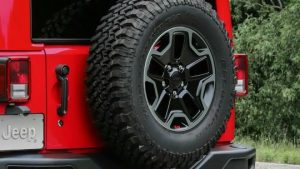
“Where’s the spare?”
This is a question you don’t want to be asking yourself when you’re on the side of the road with a flat.
That’s why it’s good to know one of the newest trends in the car manufacturing industry. The trend? Some cars today aren’t coming with spare tires. In its absence, you might find a tire-inflator kit, air compressor, and a can of sealant.
This is an important question to ask when you are looking for a new vehicle: does it come equipped with a spare tire? That way you can make an informed decision.
Many carmakers eliminated spare tires to improve fuel economy – and reduce production costs. Some car manufacturers provide an inflator kit, and others provide run-flat tires, which can be driven for limited distance. Keep in mind that run-flat tires are often more expensive to replace and don’t ride as smoothly.
Some manufacturers have also stopped providing spare tires because today’s tires are more reliable than they were in the past.
Spares can run 45-pounds, reducing your gas mileage just in order to haul around a part you’re not using. However, inflator kits are only useful if you have a small puncture in the tread. For a sidewall puncture or worse you’re out of luck.
This means you’ll have to call a tow truck and hope there’s a replacement tire available that doesn’t need to be ordered. Depending on if you drive during the day or late at night, repair shops could be closed for the night, making their tire selection irrelevant.
So, what’s a car buyer to do?
First assess your needs. Where do you live? Where do you usually drive your car or truck?
If you’re out in the country a spare tire could save you a huge tow truck bill. If it’s going to take a while for a tow truck to reach you, having a spare could save you from running out of gas to keep warm while you’re waiting for assistance. Depending on how far away you are from civilization this could be dangerous, especially for the elderly and children.
If you’re driving in town, a short distance to the nearest gas station isn’t such a big deal. If parts need to be ordered it’s easy to get home anyway. Ditching a spare could save gas money and the environment.
The important thing is that you’ve thought about what makes sense for you. Many car models that don’t come with spares have kits or spare tires you can purchase separately. Inquire if the vehicle you’re interested in is one of them. The key is to find out before you find yourself on the road shoulder making calls!
Contact us
Call or stop by Thelen Auto Group to discuss what features to look for in a car when safety is at the top of your list of “must haves.” We’re happy to share our knowledge with our customers so you can drive home with peace of mind.
Links:
http://www.iihs.org/iihs/ratings
http://www.roadandtrack.com/car-culture/a26194/not-having-a-spare-tire-is-stupid-and-dangerous/
https://www.consumerreports.org/cro/news/2014/10/where-the-heck-is-my-spare-tire/index.htm
https://www.consumerreports.org/car-safety/lane-departure-warning-lane-keeping-assist-guide/
https://mycardoeswhat.org/safety-features/lane-keeping-assist/
4 Things You May Not Know A New Vehicle Can Do
Make your life easier
If you’re like most people, you don’t read the owner’s manual. You know how to drive your car and you figure that’s all you really need to know. However, there are some surprising vehicle features you should be aware of because they can make your life easier – and safer.
These include:
- Electronic Parking Brake
- Hill Start Assist
- Back Up Camera
- Technology
Electronic Parking Brake
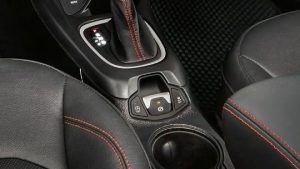
You might be thinking, “Really? Everything is becoming electronic these days! What’s the advantage of making electronic what can be done so easily? Are people that lazy?
- While an electric parking brake isn’t necessary per se, there are a number of advantages.
- It takes up less room than a brake handle.
It’s also safer. The car decides to brake rather than the user. You might think you know when it’s appropriate to break, but let’s face it, there are some scary drivers on the road. If vehicles come equipped with electronic parking brakes, there is less chance of “operator error” that causes something such as a vehicle rolling down a hill and causing an accident.
Hill Start Assist
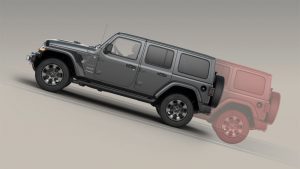
While most of us are perfectly capable of braking, there’s a time gap between releasing the brake and applying the accelerator that you might not have considered. Hill start assist prevents roll-back when starting your car on an incline.
Hill start assist will hold the break on momentarily while your foot moves from the break to the gas. Without this technology, during the switch your car could roll back (or forward) and hit another car before you can apply the gas to pull away. Simply put, hill start assist holds the break for you while you move between peddles.
Back Up Camera
Wouldn’t it be great if the next generation didn’t know what a “blind spot” meant? Safety would be standard.
Luckily, this is already becoming a reality. Companies such as Vehicle Interface and Uconnect have designed cameras so drivers can monitor what’s going on behind them in what would otherwise be their blind spot.
This technology comes in especially handy when you’re backing out of the driveway. Every year in the U.S., some 292 people are killed and 18,000 are injured by drivers backing up. Daunting numbers that can be avoided.
Young children in the driveways of their own homes are especially at risk because of their height. When children are sitting down, they’re even harder to see. The elderly are also at an elevated risk.
Large blind zones prevent drivers from seeing objects behind the rear bumper. The average blind zone is anything within about 27 feet of the rear bumper. This means glancing back and using mirrors isn’t enough if an object – or a person – is close enough. SUVs and pickup trucks typically have the biggest blind zones and are involved in more back over accidents than cars.
Backup cameras reduced the blind zone by about 90 percent in one study.
The National Highway Traffic Safety Administration (NHTSA) may require cameras on passenger vehicles in the future.
The Internet of Things
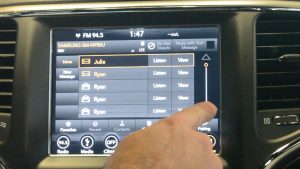
Through technology such as Uconnect and the Guardian app, we now you can control our vehicles with a push of a button almost anywhere we are (If you’re vacationing in Antarctica the feature might not work so well!).
Features include:
- Starting
- Stopping
- Locking
- Unlocking
If it’s cold outside, start your car while you’re putting on your coat or, better yet, about 10 minutes before you’re ready to go. Gone are the days of finally warming up only to be at your destination.
There are also numerous safety features that Uconnect technology offers. Find your truck if you forgot where you parked. Need directions to a destination? (Seriously, technology is spoiling us!)? No problem. Just input the address into the app and you’re good to go!
Call roadside assistance or stolen vehicle assistance and more if anything else should happen on your journey. Although, we hope it never comes to that!
Uconnect safety features include:
- SOS Call
- Roadside Assistance Call
- Theft Alarm Notification
- Stolen Vehicle Assistance
- Remote Vehicle Start
- Remote Door Lock/Unlock
- Remote Horn & Lights
- Send & Go
- Vehicle Finder
Look to the future!
Car designers have used technology to make vehicles safer and more convenient. Think about what features you might when shopping for your next ride!
Contact us
Call or stop by Thelen Auto Group and ask us about the latest features for more information or a demonstration. We’re happy to provide more information to help you decide which features are right for you!
Links:
https://oppositelock.kinja.com/in-defense-of-the-electronic-parking-brake-1444951189
https://mycardoeswhat.org/safety-features/hill-start-assist/
https://www.driveuconnect.com/
https://www.siriusxm.com/guardian
Connect with us


